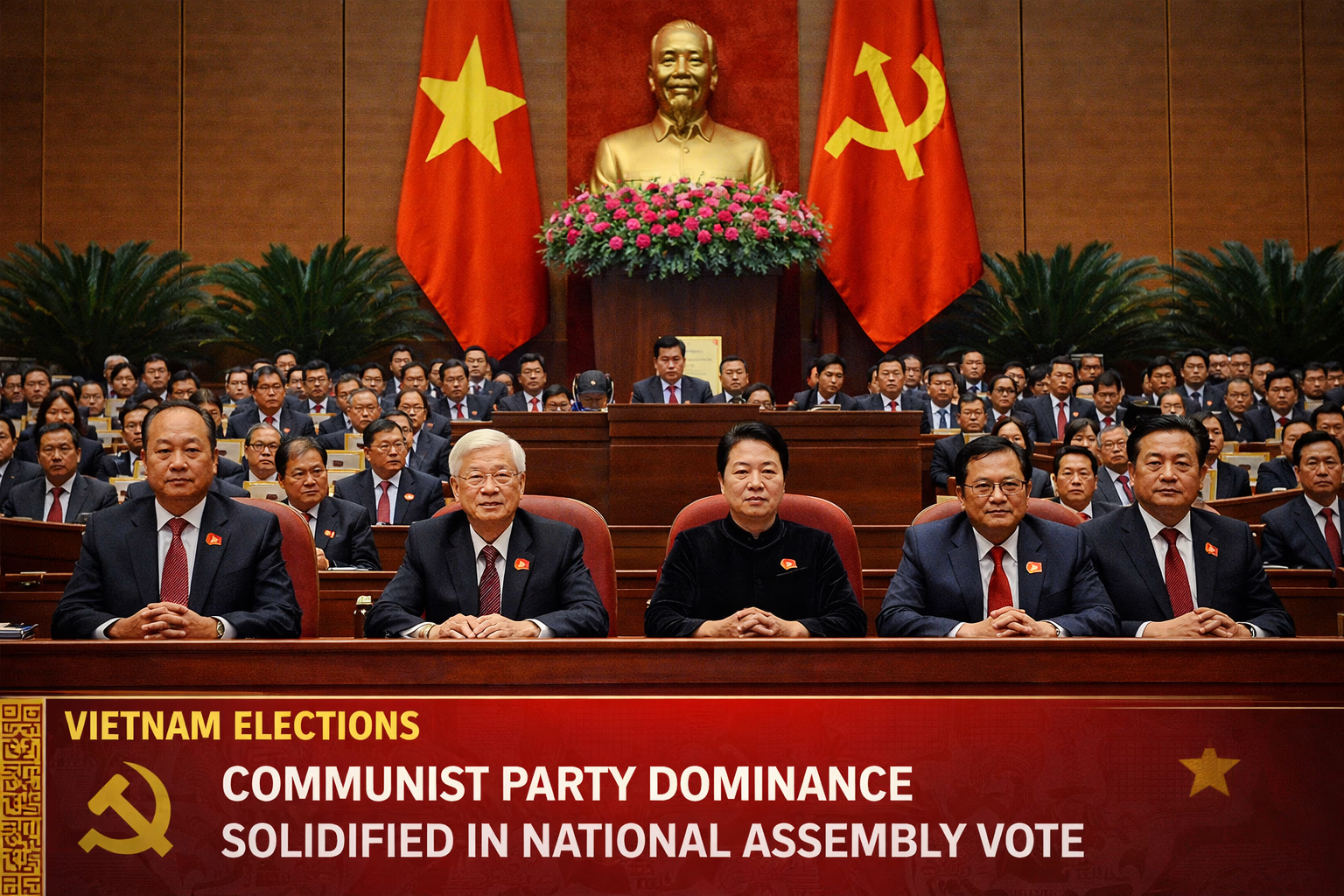
Vietnam Concludes National Assembly Election Under Dominant Communist Party System
Vietnam has held its nationwide general election for the National Assembly, the country’s legislative body. An overwhelming 93% of candidates running were affiliated with or endorsed by the ruling Communist Party of Vietnam (CPV).
This election once again highlights Vietnam’s single-party political system, where voter choice largely revolves around a pre-approved list of candidates. The National Assembly, while constitutionally described as the highest state authority, primarily functions to ratify policies determined by the Communist Party leadership.
Reinforcing the Communist Party’s Dominance
In a characteristic display of its entrenched political structure, Vietnam has concluded its nationwide general election, reinforcing the dominant role of the Communist Party of Vietnam in shaping the country’s legislative direction.
Citizens across the Southeast Asian nation voted for representatives to the National Assembly, the highest state authority in the country. However, the electoral landscape remained highly uniform. Approximately 93% of all candidates were either direct members of the CPV or officially endorsed by the party.
While multiple candidates may appear on ballots for individual seats, the overwhelming majority represent the same ideological and organizational framework. This structure ensures the Communist Party’s continued control of legislative authority, with the National Assembly often functioning as a body that formally approves policies developed by party leadership.
Understanding Vietnam’s Unicameral Legislative System
The National Assembly in Vietnam is theoretically responsible for drafting legislation, overseeing government activities, and making decisions on major national matters.
In practice, however, it is widely viewed as a consultative institution that legitimizes the policy direction of the Communist Party. The strict screening and approval of candidates demonstrate the party’s commitment to maintaining political stability and centralized governance — a model that has shaped Vietnam’s political trajectory for decades.
Critics argue that the absence of genuine political competition limits democratic choice and reduces elections to a process aimed primarily at public mobilization and symbolic participation.
Supporters of the system, however, emphasize that political unity and centralized decision-making have contributed to Vietnam’s economic growth, social stability, and long-term development planning.
Governance Models in a Global Context
Vietnam’s electoral process offers an important example when examining different governance systems around the world.While many countries face intense political rivalry and geopolitical tensions — such as the recent US military tragedy in Iraq amid surging Iran tensions — Vietnam maintains a tightly controlled domestic political structure.This environment enables long-term strategic planning, although it offers limited space for political opposition or major ideological shifts.
The Vietnamese model prioritizes ideological coherence and centralized authority as tools for guiding national development.
Implications for Vietnam’s Political Future
The results of the election are not expected to bring major policy changes or challenges to the Communist Party’s authority. Instead, the outcome reaffirms the party’s continued mandate and introduces a new group of representatives expected to support its agenda.
As Vietnam continues expanding its economy and strengthening global engagement, global analysts also remain focused on conflicts shaping international security dynamics, including Israel’s endgame in Lebanon and what seized territory reveals about its long-term strategy. Observers will closely watch how the country balances its centralized political system with the pressures and expectations of an increasingly interconnected world.